Case study · Spotify for Artists
Making promotion approachable.
I designed the onboarding system that introduced Marquee, Spotify’s first self-serve promotional tool, helping artist teams understand its value and confidently create their first campaign.
- Role
- Product Designer
- Partners
- Product · Engineering · Marketing · Design Systems · UX Writing
- Timeline
- 1 year
- Focus
- Product strategy · Onboarding · UX/UI · Web platform
A proven tool was not yet a self-serve product.
When I joined the team, Marquee was being tested through a white-glove alpha program run by the Sales team. Artists had not yet been introduced to it through onboarding or marketing, and the move to self-serve created a new set of product questions.
Alpha research made the trust gap concrete. Artists did not want to read a manual. Before spending, they wanted to understand the value, see pricing clearly, know what they might get in return, and learn while doing.
Low awarenessArtist teams did not know Marquee existed or what it could do.
Unclear mechanicsUsers did not fully understand how the promotional tool worked.
Value uncertaintyThe return on paid promotion felt unclear or intimidating.
Build confidence progressively, not all at once.
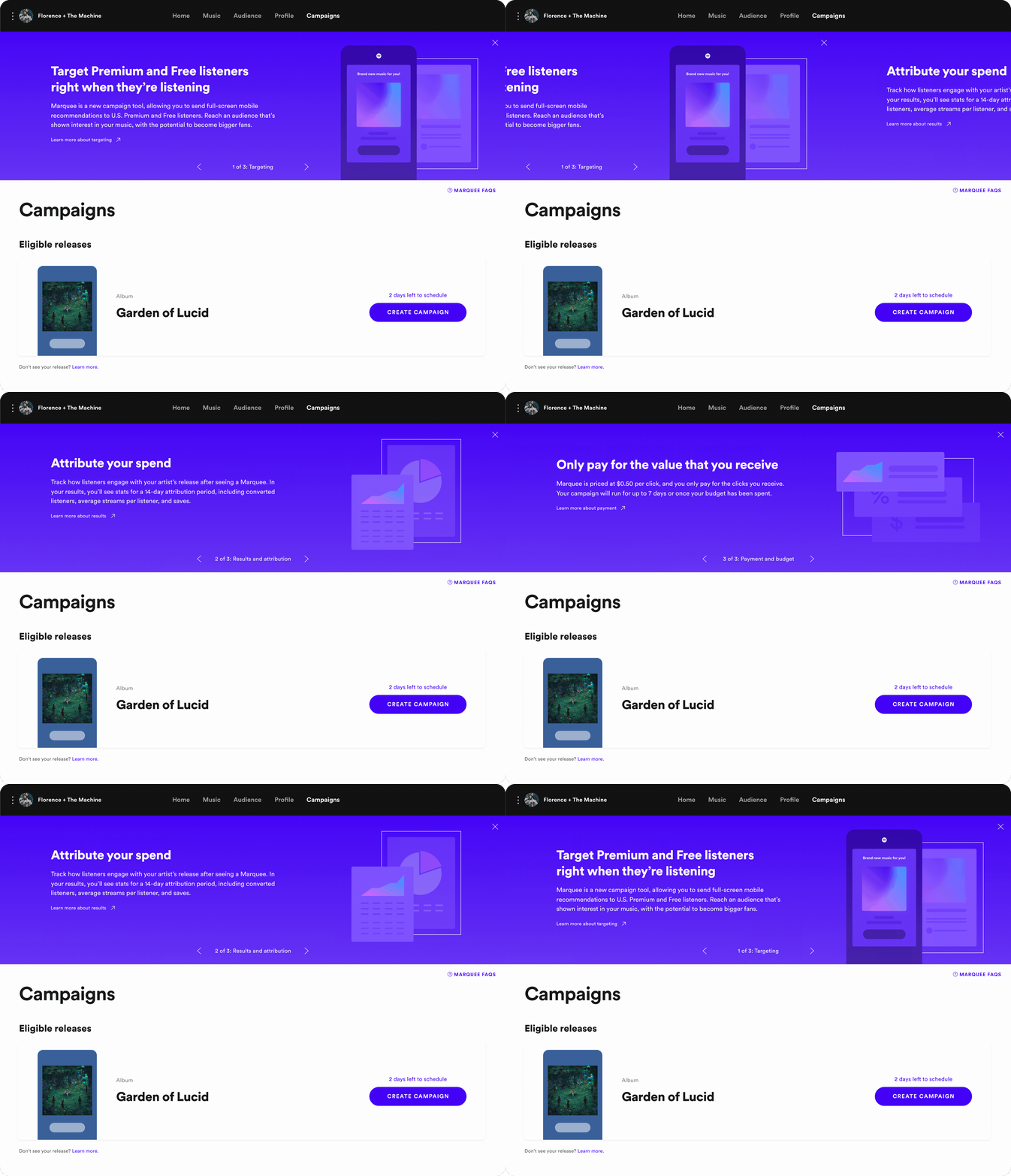
I reframed onboarding as a system of connected moments instead of one heavy walkthrough. Marquee appeared where it made sense: a Home callout for discovery, a persistent Home card after dismissal, contextual education on Campaigns, and a permanent route to FAQs.
The experience led with artist value before mechanics, let people opt out without losing access to information, and supported both teams with an eligible release and those planning for a future one.
Lead with valueStart with what artists gain, not how the tool works.
Meet users where they areSurface Marquee at natural moments across existing flows.
Make opting out easyLet users dismiss education without losing access to it.
Remove frictionKeep the path to a first campaign direct and understandable.
Turn every edge case into one shared implementation document.
The interface had to respond to role, permission, release eligibility, dismissal history, and entry point. I translated that complexity into detailed user stories showing who saw each touchpoint, when it appeared, how it behaved, and where education remained available.
I partnered closely with my PM to maintain the logic in one shared source of truth. That artifact reduced back-and-forth and aligned Engineering, UX Writing, Marketing, and Design Systems around the same experience.
The system behind the screensAdmins, editors, and viewers could encounter different states; eligible and ineligible teams needed different information; and dismissal could never become a dead end.
The beta showed that progressive onboarding was working.
The controlled beta showed no major onboarding drop-off and strong completion once campaign creation began. It also gave the team a precise iteration agenda: make the copy more value-forward, tighten education, clarify re-entry, and improve dismissal logic.
73%Booking completion36 of 49 beta artists completed the full booking flow.
93%Campaign approvalThe remaining 7% were not approved due to content moderation.
~$30KRevenue above forecastDelivered revenue exceeded the 2020 self-serve forecast.
~$400Budget above forecastAverage user budgets exceeded the original forecast.